
🎓 EdTech · Multi-tenant SaaS
A school platform that starts by telling schools what to digitise first
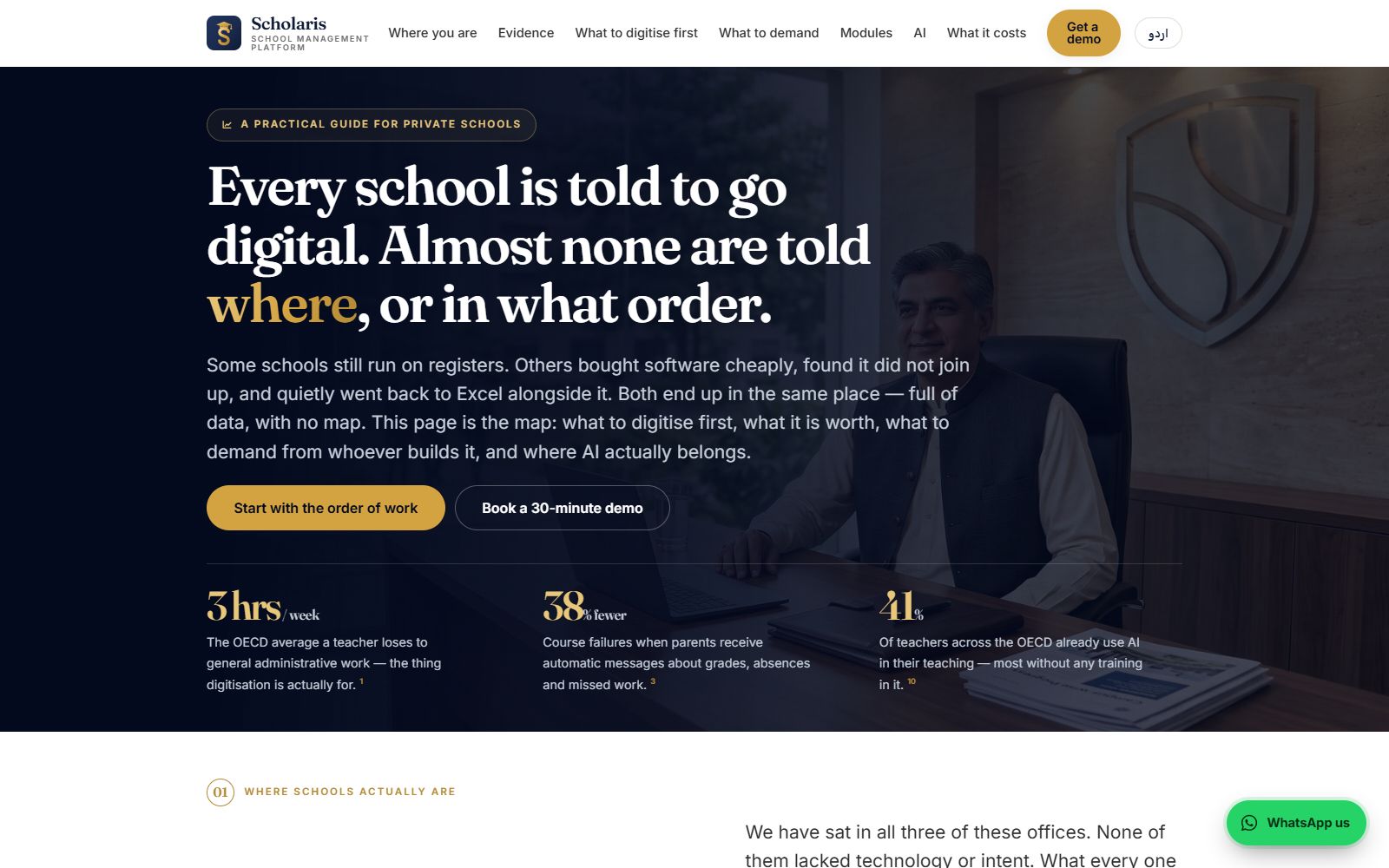
Every school is told to go digital. Almost none are told where to start, or in what order. Scholaris is 22 modules and an argument about the sequence to adopt them in.
- Sector
- Education · Multi-tenant SaaS
- Our role
- Product design, engineering, hosting and operations
- Status
- Live in production
- Scope
- 22 modules, multi-campus
The problem
Two kinds of school end up in the same place. One still runs on paper registers. The other bought something cheap, found that the fee module did not speak to the attendance module, and quietly went back to Excel alongside it. Both are now full of data with no map.
The gap is rarely features. It is sequence. Nobody tells a principal which function pays back first, what a module is worth once it is running, or what to demand from whoever builds it.
What we built
Scholaris is a multi-tenant platform covering 22 modules — admissions, fees, attendance, examinations and reporting among them — designed so a group can run several campuses from one place without each becoming its own island of data.
The marketing site is unusual, and deliberately so. Instead of a feature grid, it is a guide: where you are now, what the evidence says, what to digitise first, what to demand from any vendor, and where AI genuinely belongs rather than where it sells. The claims carry citations. A school that reads it and buys something else has still been helped, and we were content with that trade.
- Multi-tenant and multi-campus from the schema up, not as a later flag.
- An agentic AI assistant. It answers from the school’s own records by calling the platform’s tools rather than guessing, and every change to it is scored against an evaluation suite first.
- Live video built into the platform rather than bolted on beside it.
Where the AI sits
Last, and deliberately so. An assistant that answers a parent about a fee deadline can only do it if the fee records are already in the system and already correct — which is why the guide puts AI at the end of the order of work rather than the front of the brochure.
What makes it useful is that it does not guess. The assistant calls the platform’s own tools to look a thing up, so an answer about a balance is the balance, not a plausible number. It is grounded in the school’s own records, and every change to it runs against an evaluation suite before it ships — because the failure mode of a confident wrong answer to a parent is worse than no answer at all.
There is a second strand: an AI literacy curriculum for students, with a supervised lab, graded activities and teaching prompts. Schools are being told to teach this; very few have been handed the material to teach it with.
The engineering
A single-page application on the front, a separate API, and a relational database, all containerised and deployed through an automated pipeline. The front end is split into the application and a separate marketing site, so publishing a content change never touches the system that schools depend on during admissions week.
Multi-tenancy is the decision that everything else inherits. It is cheap to add at the start and extremely expensive to retrofit, so tenant isolation runs through the data model rather than sitting in application code where a single missed filter leaks one school’s records into another’s report.
Why it matters for your project
If you are building SaaS that several organisations will use at once, the hard parts are isolation, reporting across tenants, and a permission model that survives contact with real institutions. Scholaris is where we have solved those at scale.
Switch sizes
🚀 Keep looking